

CASE STUDY
Canadian National Police Service
From Reactive Policing to Proactive Performance
How CN Police Service used culture data, leadership commitment and employee dialogue to transform performance
Canadian National Police Service (CNPS) is a specialized police force whose purpose is to protect and promote CN’s people, business and reputation. With approximately 125 employees operating across multiple regions in Canada and
the United States, CNPS plays an important role in keeping CN’s rail network safe, secure and moving.
When Steve Covey became Chief of Police in 2010, he inherited an organization lacking clear direction, consistent professional standards and common goals. Officers were doing their jobs, but largely reacting to situations rather than working proactively against shared priorities. Covey wanted CNPS to become a more professional, strategic and high-performing police service that could demonstrate greater value to CN.
CN depends on network fluidity. CN Police contributes by helping prevent incidents and, when incidents occur, responding effectively so trains can get moving again as quickly as possible. Like many organizations, CNPS was also under pressure to do more with less, making productivity and a clear focus on the work that mattered most increasingly important.
Covey recognised that improving processes alone would not be enough. The underlying culture also needed to change.
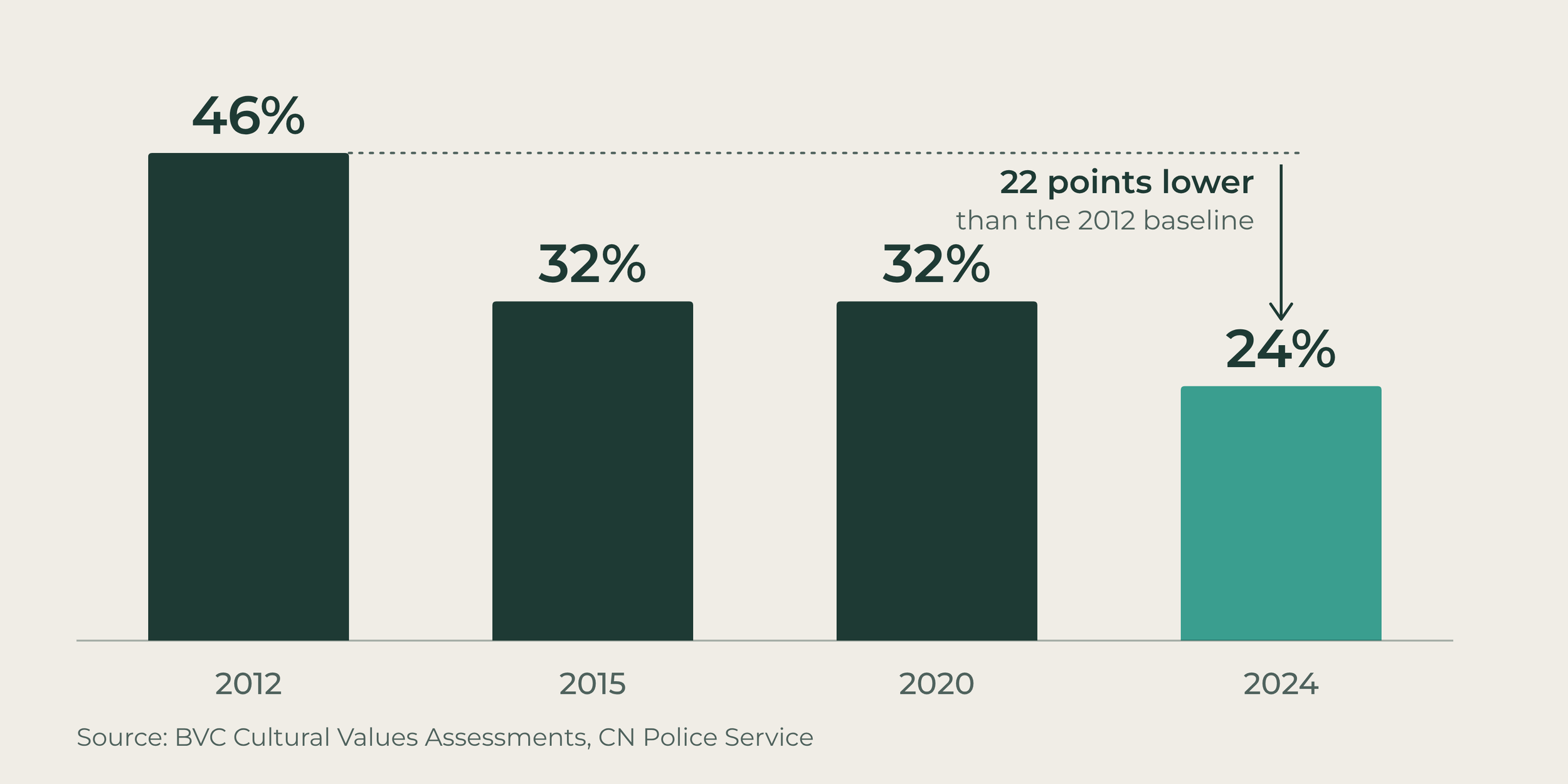
Working with Carol Ring of Culture Connection, CNPS conducted its first BVC Cultural Values Assessment in 2012. The results provided a stark baseline: Cultural Entropy® was 46%, and the current culture included potentially limiting values such as confusion, control, bureaucracy, hierarchy, blame, manipulation and information hoarding. Employees wanted something different, identifying values including accountability, open communication, teamwork, professionalism, information sharing and respect.
The Challenge
CNPS treated the assessment as the beginning of the conversation, not the end.
Covey personally travelled to meet employees and understand what was behind the results. One of the most revealing findings was confusion. Leadership had been working hard to create greater clarity by introducing policies, defining responsibilities and communicating changes. Employees, however, experienced the volume and pace of those changes as overwhelming. By asking rather than assuming what the data meant, CNPS was able to uncover the issue beneath the number.
Those conversations informed a prioritised action plan and, working with Ring, the development of the CNPS Compass. The Compass brought together CNPS’s purpose, vision, core values, commitments, and strategic and operational priorities. Its five core values - Integrity, Professionalism, Respect, Teamwork and Accountability - created a common foundation for the organization.
CNPS continued to measure its culture over time, using subsequent assessments to understand progress, identify emerging issues and refocus leadership attention when necessary.
The Solution
Cultural Entropy fell from 46% in 2012 to 24% in 2024 (lower Cultural Entropy = less concern | Higher Cultural Entropy = greater concern). By 2024, accountability, safety and teamwork were the three highest-ranked values in the current culture, and the assessment achieved 95% participation with 120 employees contributing their perspectives. Operationally, crossing and trespassing incidents declined by approximately 50%, while theft of customers’ goods was almost eliminated, including a dramatic reduction in theft in the greater Chicago area.
The transformation was not a straight line. At one point, leadership attention shifted and Cultural Entropy increased again. That experience reinforced one of CNPS’s most important lessons: culture transformation requires sustained leadership attention and regular measurement.
The Outcomes
“When you embark on something like this, you must understand it’s a long-term process. It’s not a survey; it’s a journey. You must be intentional in making it happen, with a strong commitment. Don’t
let it slip - it has to stay front of mind.”

Carol Ring is a certified culture consultant, executive coach, speaker and author. Her books include IGNITE Your Culture and the international bestseller People Problems Solved.
Carol holds the FCPA designation, which is reserved for CPAs recognised by their peers for exceptional contribution to the profession. She has completed the Judy Project Executive Program at the Rotman School of Management. Her specialised certifications include Barrett Values Centre Culture Transformation Tools, Brené Brown’s Dare to Lead Program, and Wiley’s Leadership Challenge Practitioner.
Her recognitions include being named one of Canada’s Top 100 Most Powerful Women and Woman of the Year by Canadian Women in Communications. She has served as Chair of the Greater Ottawa Chamber of Commerce and on the Board of Governors of CMA Canada.