Excerpt from Love, Fear and the Destiny of Nations: The Impact of the Evolution of Human Consciousness on World Affairs
This reading is excerpted from Richard Barrett's upcoming book.
Throughout human history, individuals and societies have always focused their energies consciously or subconsciously on a central key idea that could, if sufficient energy and effort were devoted to it, help them move towards a more idealized future—a future that would in some way make their individual and/or collective life experience better and assuage their fears.
This central key idea has come to be known as “development.” At this point in our human history, the central key idea—the vision that we have collectively accepted that will lead us to a more idealized future is development as economic growth. This is the story that leaders of our nations and the global financial institutions are telling us, but it is not what is in the hearts and minds of the people.
Understanding the Battle of the Sexes: The Effects of Gender on Leadership Styles
To date, only 28 of CEOs in Fortune 1000 businesses are women. However, record numbers of women are now entering business school. While only time will tell what impact this potential influx of women leaders is going to have on organisations around the world, we recently conducted a research project to examine the perceived differences of male and female leaders. Our study consisted of data collected from 100 LVAs conducted between 2008 and 2010. Which gender tends to work "long hours"? Which gender is seen to focus on "developing people"? Which gender is recognised for their "delivery" and being "solutions oriented"? The answers may surprise you.
A Leadership Development Learning System for the 21st Century Leader
If we are going to survive and prosper individually and collectively in the future we need a new leadership paradigm and a new breed of leader. We need leaders who recognise that business is a wholly owned subsidiary of society, and that society is a wholly owned subsidiary of the environment. If we lose our environment and our life-support systems, our society will perish. If we lose our society, we will lose our economy, and our businesses will fail.
Evolutionary Coaching
Imagine for a moment that you had a coaching process that was based on the principles that have been responsible for 14 billion years of successful evolution. Imagine that these principles are simple to understand and furthermore, imagine that you could measure individual and collective human evolutionary progress. Now imagine that through applying these principles and measuring techniques you could make the evolution of human consciousness conscious by facilitating the unfolding of individual and collective human potential.
Building a High Performance Organisation to Withstand Turbulent Times
Events such as the economic crash of 2008, rapidly fluctuating currency rates, the volcano eruption in Iceland in 2010, and in 2011, the earthquake and tsunami in Japan, the chaos that has enveloped the Middle East in the people's struggle for democracy and the UK government's rigorous budget cutbacks. It makes it really hard to run a business when you are constantly being sideswiped by unanticipated events that impact your market place.
Stages in the Evolution of Democracy
Recent events in the Middle East and their repercussions in other parts of the world have refocused global public attention on the unfolding story of democracy. Democracy is far from mature as a concept. It is poorly understood, open to misinterpretation, often abused, and almost exclusively birthed through public unrest, violence, or civil wars. It is always taken; it is never given.
The New Leadership Paradigm: An Evolutionary Leadership Development Programme
According to scientists, everything that exists in our world began 14 billion years ago with a “Big Bang.” After that, it was all about evolution. The evolution of energy into matter; matter into living organisms; living organisms into creatures; and one of those creatures—Homo sapiens—is now involved in attempting to carry the baton of evolution to a new level—we are attempting as a species to make the concept of humanity palpable.
The New Leadership Paradigm: A Response to the Global Leadership Crisis
This paper looks at the current moral state of our society and the poor performance of our political and business leaders. It identifies the underlying issues of the current leadership crisis and the need for a new leadership paradigm—a shift from being the best in the world to the best for the world; a shift from what’s in it for me to what’s best for the common good; and a shift from “I” to “we”.
The Universal Stages of Evolution - Lessons for Leadership Development
This paper places leadership development in the context of the evolution of consciousness from the Big Bang to the present day. It identifies the five characteristics that are at the core of all successful evolution and integrates them into a four-part process for leadership development that supports the continuing evolution of Homo sapiens. This paper is an extract from Richard Barrett’s soon to be released book, The New Leadership Paradigm.
A Values Based Approach to Cultural Resilience
This paper focuses on actions that you can take and values that you need to focus on to build the resilience of your organisation.
Coaching for Cultural Transformation
This paper describes in detail, with examples, how the Individual Values Assessment and the Leadership Values Assessment are used for coaching supervisors, managers and leaders.
Cultural Capital - A fundamental driver of financial performance
This paper explores the topic of cultural capital and its relationship to financial performance. It reviews research on this topic and comes to the conclusion that even though there is no direct measure of cultural capital, proxy measures such as cultural alignment and cultural entropy clearly indicate a positive correlation between cultural capital and sustained high revenue growth.
Six Modes of Decision Making
There are four stages involved in decision-making—data gathering, information processing, meaning-making, and decision-making, and three possible outcomes—a reaction, a response or guidance that leads us into a process of reflection.
Full Spectrum Sustainability
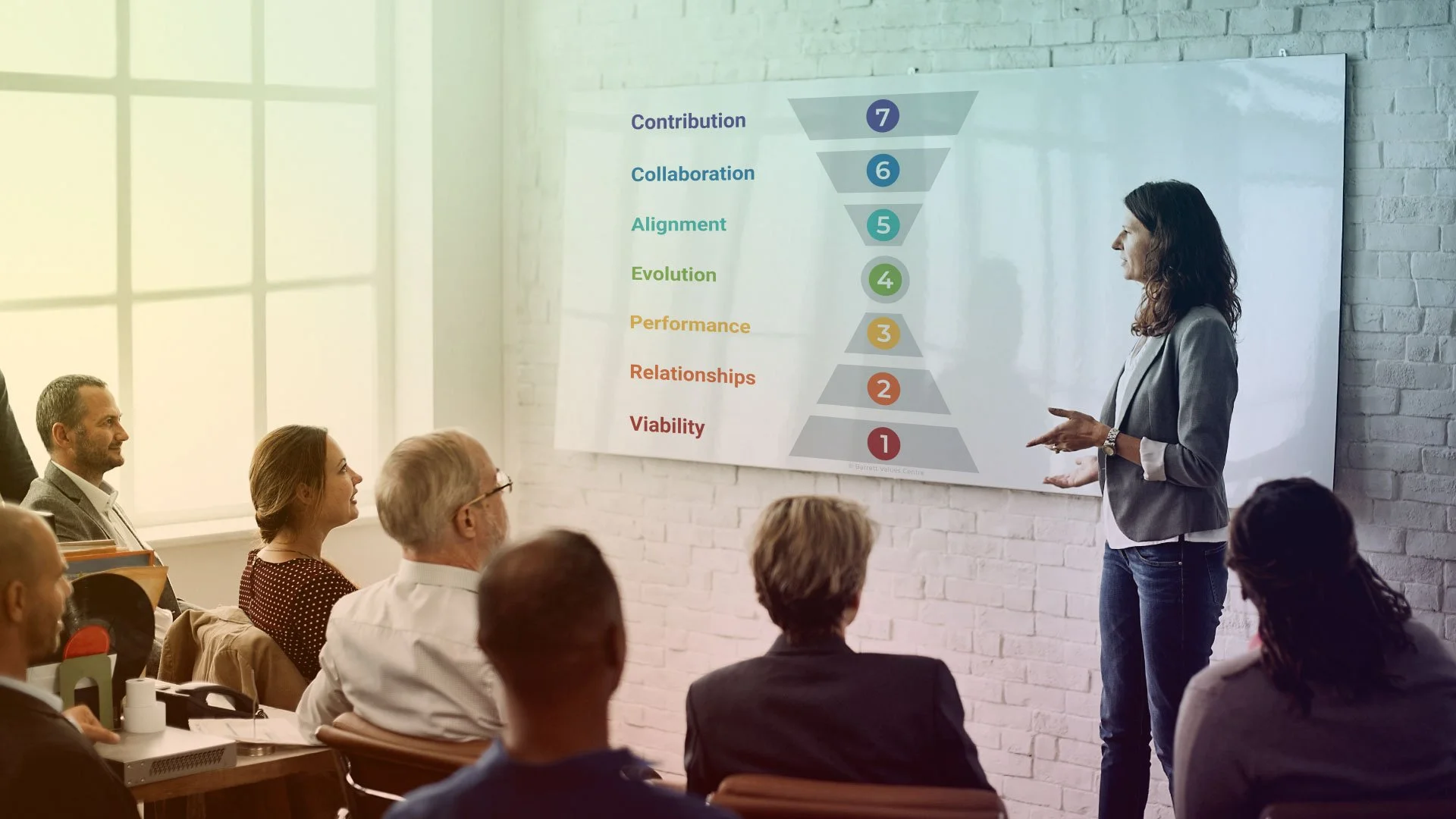
This paper explores the concept of full spectrum sustainability—both being sustainable, and embracing sustainability—with reference to the model of the seven levels of organisation consciousness.
Fundamentals of Cultural Transformation
This paper explores the concept of whole system change. It identifies the four principles necessary for whole system change, and provides a nine step process for implementing cultural transformation.
High Performance - It's all about entropy
This paper examines a) the impact of the personal entropy of the leaders of an organisation on the cultural entropy of their organisations, and b) the impact of the cultural entropy on the organisation’s performance. In order to improve the performance of an organisation it is necessary to reduce personal entropy of the leaders.
The Importance of Values
Values stand at the very core of human decision?making. When we work in an organisation whose culture aligns with our personal values, we feel liberated. We are able to bring our full selves to work. We not only bring our energy, our creativity, and our enthusiasm, we also bring our commitment to the well?being of our associates and the success of the organisation. Unleashing this energy is tantamount to liberating the corporate soul.
A New Business Paradigm
The basic premise of this paper is that to survive and prosper in the 21st century, business will need to develop a new business paradigm—one that embraces the global common good rather than individual self?interest. A paradigm based on vision?guided, values?driven leadership that targets not only the business success of the company, but also the well being of all stakeholders—employees, customers, investors, partners, society and the environment—nothing less than full spectrum sustainability.